


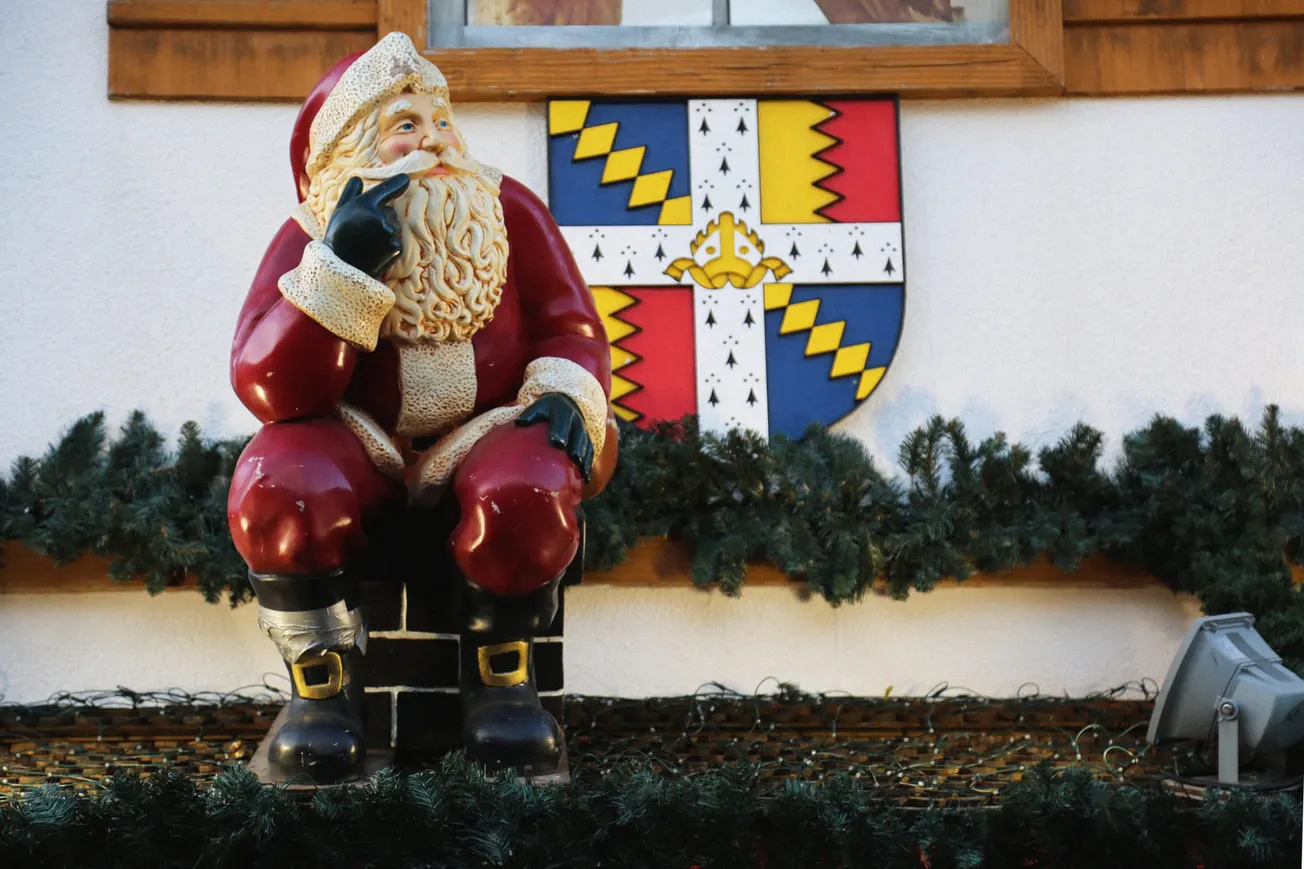
Dear readers — today's article, about Birmingham's realtionship with its Christmas markets, is a winter warmer of a feature as the nights grow darker and the days draw in. You're welcome.
Have you been to the Christmas markets? Are you an ardent supporter or a sceptic? Let us know in the comments.
Christmas is nigh and we’re feeling festive at The Dispatch. It’s been a fantastic, hectic year, so what better way to celebrate than bringing our community together in a beloved local bar and getting them to duke it out for a £100 cash prize?
That’s right; on 18 December, The Dispatch is going to be hosting its very own Christmas quiz! We’ll be taking over the Jewellery Quarter’s Temper and Brown, for an evening of testing your knowledge on everything from music, history, pop culture and — of course — Birmingham.
There are now only five tickets left (at time of writing) for, what some are calling, the biggest night of the year.
So get your iceskates on and find your way to the link below.
Join us from 7.30pm on 18 December for some classic Christmas celebrations.
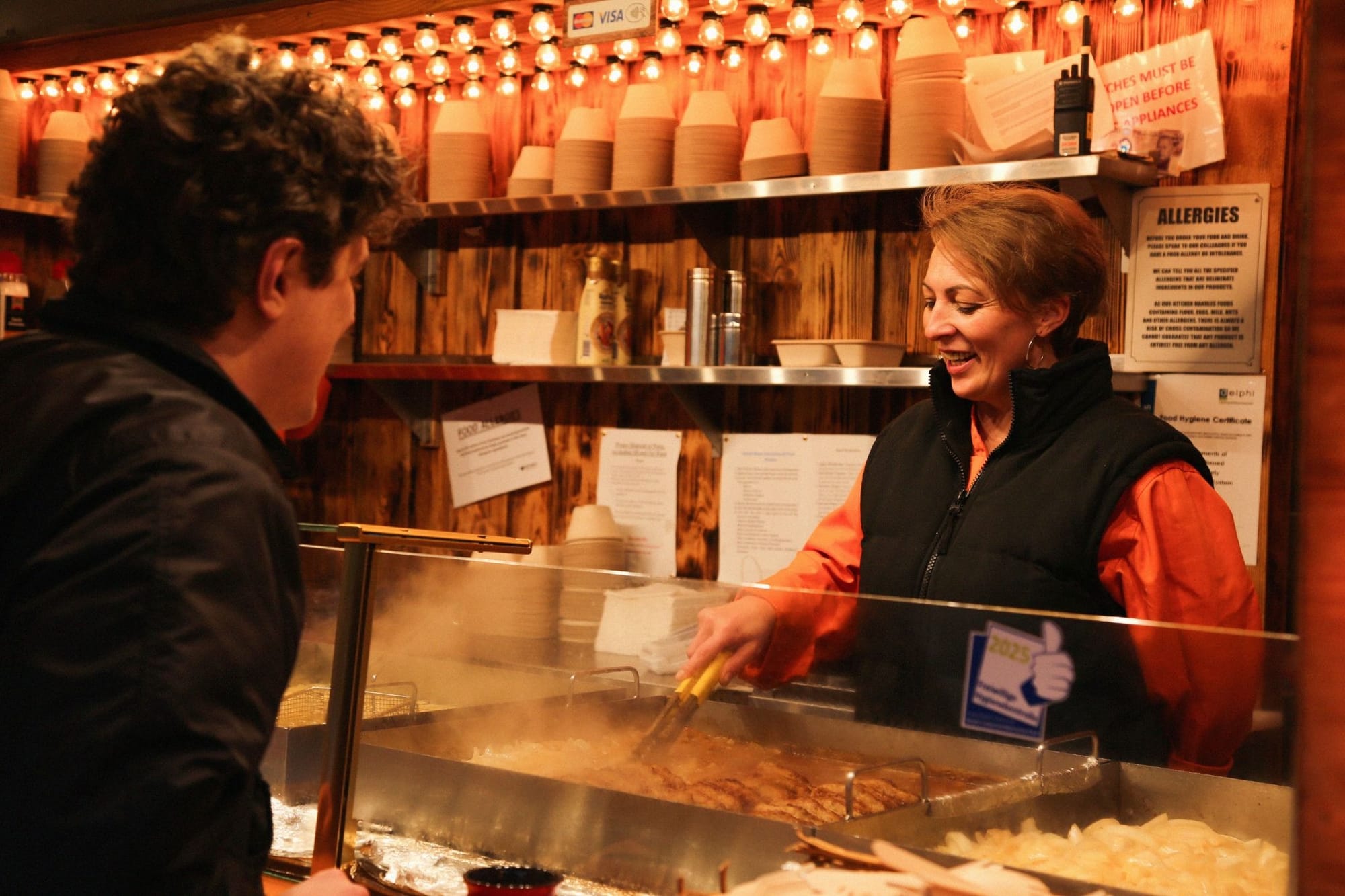
My drink is on fire, and the perpetrator is a middle-aged Romanian woman. A second earlier, she’d leant over the wooden bar separating us, and set the lethal rum and red wine concoction alight with a sugared metal prong. “Now that’s real booze, real băutură,” she informs me.
Alexandra, as we’ll call her ( she’s reluctant to give her real name), has come all the way from Transylvania to be on this wet and misty stretch of Birmingham’s Chamberlain Square, now crowded with kitsch wooden huts, blaring advert screens and droning Christmas hits from the 1980s. This is her first time in Birmingham. Alexandra hails from Cluj-Napoca, Romania’s second-city, and now, in an act of strange symmetry, finds herself in England’s equivalent.
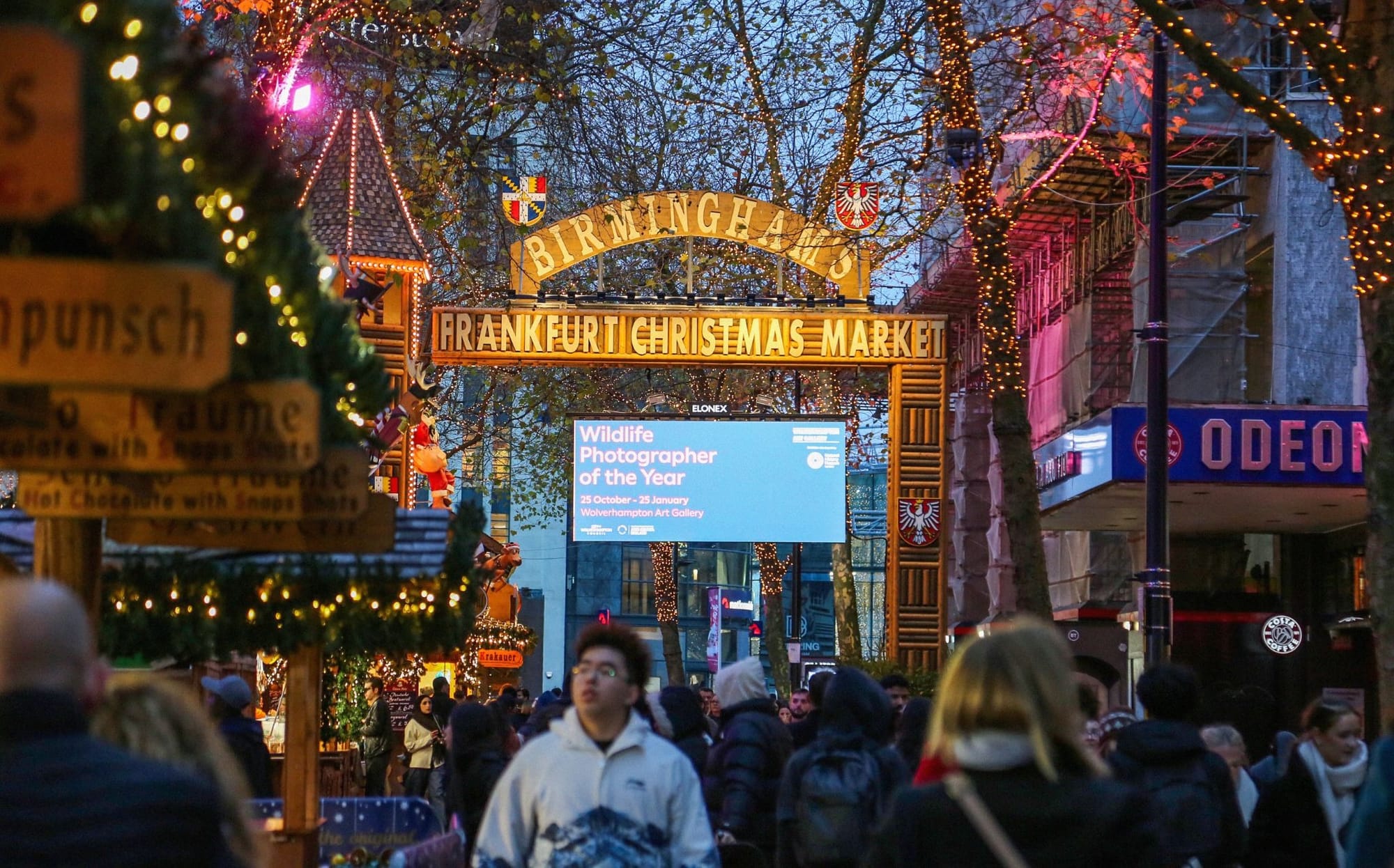
She’s one of several hundred workers who populate the city’s Frankfurt Christmas Market, which claims to be the “largest authentic Christmas market outside of Germany or Austria.” It’s been going officially since 2001 (with some early experiments in the 1990s), and every year seems to get more sprawling — and alight on Birmingham at an even earlier date.
This year, Halloween pumpkins were still freshly carved when the first stalls began to be erected on 31 October in Chamberlain Square and New Street. This is anathema to me. I’m from Sussex, the world capital of Bonfire Night celebrations. Yet over the years, Christmas, or at least the consumer version of Christmas, has somehow eaten up more and more of the calendar, like a big greedy reindeer.
The fame of the Birmingham Christmas markets never reached me before moving to the city, although, apparently, they are some of the highest profile ones in the country. During my previous festive season in Birmingham, I’d gone out of my way to avoid them. But now, more settled, I’m curious about this institution. Is there more to be found in the markets beyond £12 pints and speakers blaring Slade.
Into the chaos
There’s a certain hardness in my heart as I approach the markets on a misty November afternoon, the first pair of (fake) reindeer horns. These stalls make it a pain to get across New Street and take over one of the nicest public spaces in the city: St Phillip's Square. Plus, I prefer my ritual seasonal celebrations be a bit less commercial. Wandering around the Christmas markets provokes a disorientating sense of déjà vu — have I seen that frankfurter stall before? Did we pass that hot chocolate cabin an hour ago, or am I imagining things? I also, fairly naturally, resent paying restaurant prices for a pint.
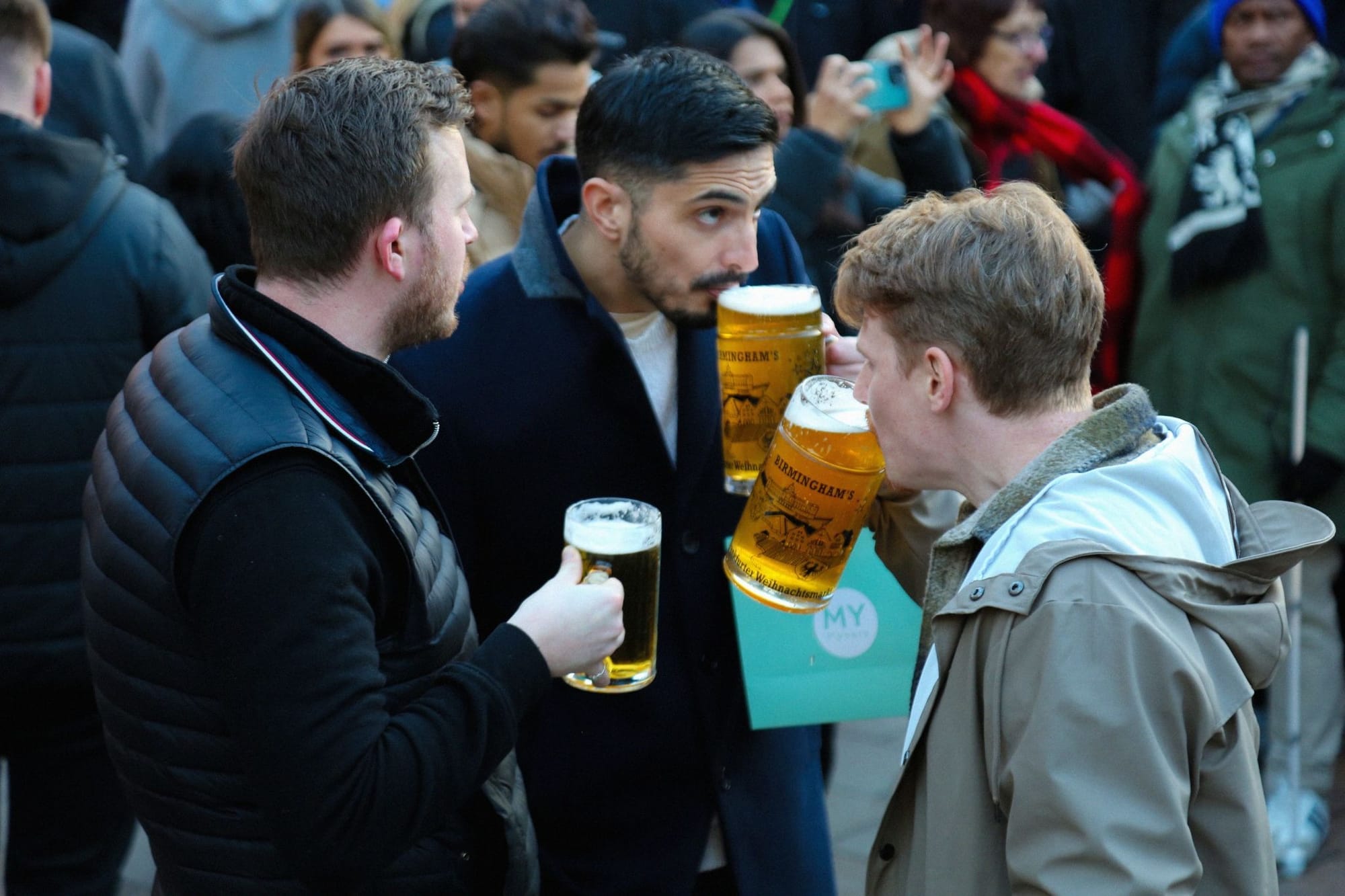
It quickly becomes clear that Birmingham’s pseudo-German market has global pull, although some are not here to browse trinkets. The first people I encounter in New Street are two teenage Mormon missionaries from Arizona and Madrid, clutching scripture. They’re obviously here to preach to the assembled crowds drawn by the markets. It's a hard gig: most people have their faces half way into various comedically large beer mugs or mouths wrapped around mustard slathered sausages.
When I bump into them, they’re chasing a young Sikh bloke down the street, desperately trying to convert him. I interject with a dictaphone and ask them about the markets, are they enjoying the Christmas cheer? What do they think about Birmingham? They look at me like I’ve just stepped off an alien space craft — isn’t this supposed to work the other way around? They keep walking, rapidly increasing their pace. I try to match them, but eventually give up: shouting into the distance my final question: “have you tried the Berliner doughnuts?”
A family from Coventry, up in Birmingham to see the ballet, are more forthcoming. “When I used to study here I found it quite annoying,” says Zoe. “Especially when catching the train, but now that I live back in Coventry I think it's part of the furniture.” She’s now a regular patron of the markets: “I’m coming again on Saturday, I love it, it's part of Christmas.”
Her father Stuart stoically concurs: “it's four or five weeks of the year, I think Birmingham can tolerate it.” Mother Dawn is apparently a Christmas zealot, and talks down my cynicism around the markets starting too early: “I love it. I mean we had our lights up a few weeks ago! I think it's brilliant. It’s never too early.”
Later on, I encounter a couple in their late twenties, down from Manchester and sipping on lager next to the council house. I find out that the boyfriend is a Brummie, and he’s back for the markets. However, he quietly agrees with me about Christmas’s dominance over autumn: “It does come too quickly,” he says. "Halloween's done and then BOOM: Christmas.”
He’s also keen to claim the Christmas market crown for the north-west: “Birmingham was one of the first places to do [markets] in the UK, and it was one of the biggest for a while, I think Manchester has the biggest one now though — it certainly feels like that.”
This might be a bit of misapplied Brummie parochialism. In fact, Lincoln’s markets are the oldest of this modern crop, starting in 1982. Additionally, it's not clear whether Birmingham and Manchester have the biggest market — although the Brum markets still advertise as the largest.” Data released by MoneyExpert reveals that, at least online, Manchester wins out in the popularity stakes, coming second in Europe in terms of searches, while Birmingham polls fifteenth.
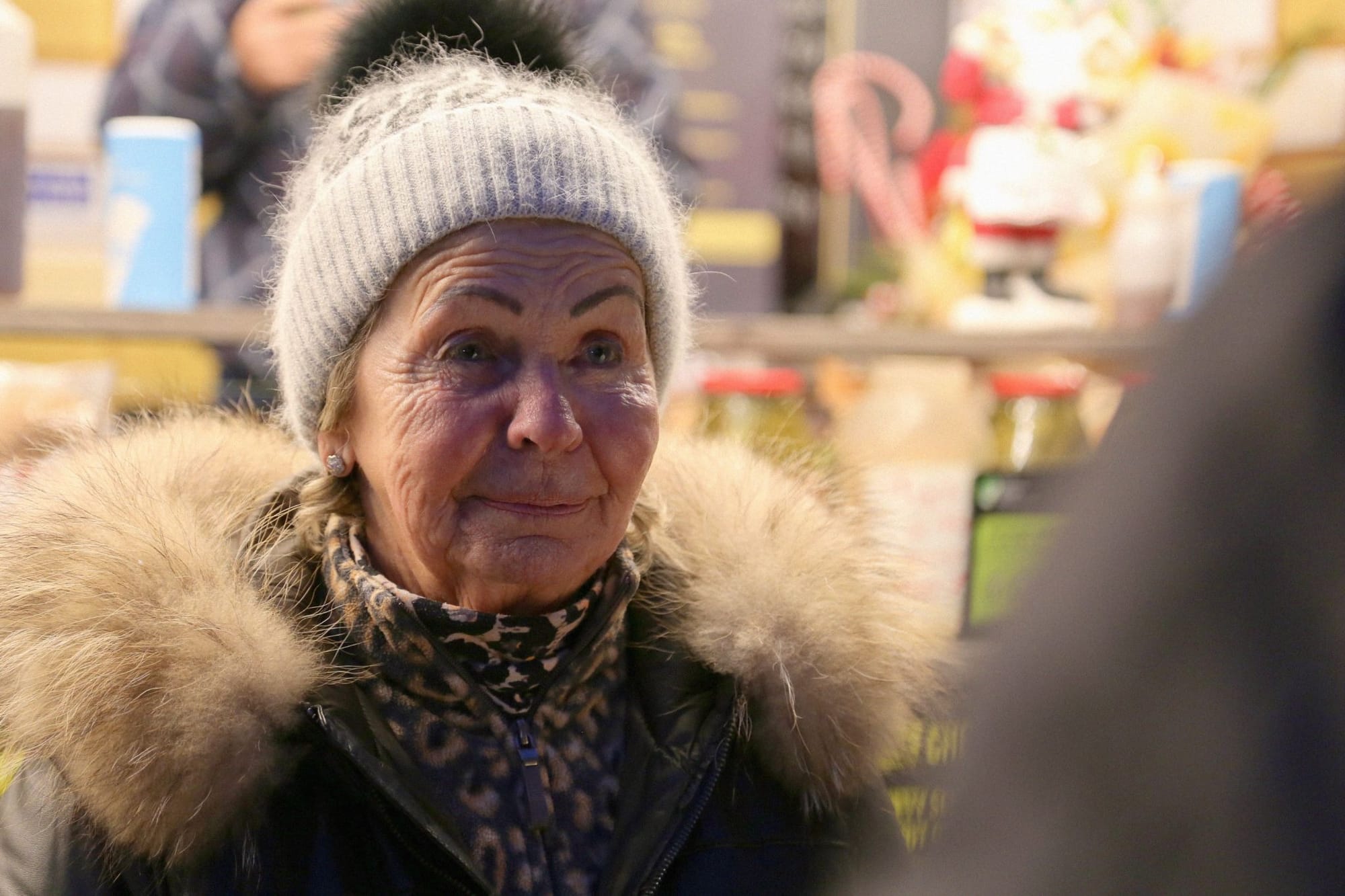
Jonathan, who has been homeless for six months, grabs a hotdog on New Street with me. The market presence “does make things a bit merrier,” he tells me. “People tend to give more money. It's pretty shit at the same time though, obviously.”
A few hours later, I find myself in St Phillip’s Square: where a Christmas crafts market has been set up. After a few beers and lots of food, I succumb to the commercialism, no longer feeling like Jesus driving money-changers from the temple. Instead, I catch myself humming along to ‘Santa Baby’ by Eartha Kitt.
Susan, a Welsh pensioner hanging out by the crepe stand seems to have caught the same mood, smiling into her mulled wine. “I’ve come from Swansea — I love it,” she says. “I come every year for the Christmas markets, and catch the last train back.”
Big cash Christmas
These markets are very big business. All these extortionately priced mulled wines and knick knacks bring home the bacon, to the tune of about £261.7 million for the city itself in increased spending on food, restaurants, transport and accommodation. The city council also picks up around £322,000 in gross revenue from the markets procuring its services (such as cleaning and security) every year, as well as a large wodge of undisclosed cash in business rates. The overall economic impact on the city is a positive £351.4 million.
This payday is delivered by a company — fairly obviously — named ‘Frankfurt Christmas Market Ltd'. Run by Marlis and Nadine Löwenthal from Bremen — former stallholders, and now managers and owners, since 1997 who hail from a long line of ‘schaustellerfamilie’ (or showman families) according to the German press. The first Christmas market pilot was launched in 1996, after a Frankfurt tourist board worker named Kurt Stroscher was brainstorming ways of promoting his city to Brits, beyond its reputation as a financial centre.
Welcome to The Dispatch. We’re Birmingham's new newspaper, delivered entirely by email. Sign up to our mailing list and get two totally free editions of The Dispatch every week: a Monday briefing, full of everything you need to know about that’s going on in the city; and an in-depth weekend piece like the one you're currently reading.
No ads, no gimmicks: just click the button below and get our unique brand of local journalism straight to your inbox.
Transplanting Frankfurt’s glitzy Christmas market seemed a winning strategy — Birmingham, twinned with the city, was the clear choice to try the scheme. Frankfurt paid for everything and by 2010, the Christmas market was such a success that Frankfurt was staging markets in Edinburgh, Manchester and Leeds as well as Birmingham.
It was worth it; between 2000 and 2010, Stroscher told the Guardian, “there was a 30% increase in British visitors to Frankfurt's original Christmas market.” The powers that be in Frankfurt seem to have taken a step back though, and the markets are now run from an office near Snow Hill station.
Obviously, this is a bit of a one-way partnership — how many Germans are coming to Birmingham to experience the Christmas market? And what Brummie products are being exported to Frankfurt, beyond academic exchanges? The answer to the first question is very few, they have the original thing back home. On average, five million people visit Birmingham’s markets each year, and 87% of them were ‘day visitors’ according to polling. So most people are unlikely to be international tourists.
It’s a microcosm of Birmingham’s general relationship with its twinned cities — Lyon is also paired with Brum. The flow of commerce seems constrained. Frankfurt is still the European capital of finance, Lyon the continent’s gastronomic powerhouse. Where does Birmingham fit in with this gang of second-cities?
The most we seem to have managed in 59 years is an exchange of young chefs between the Midlands and the Rhone. Lyon also invited Birmingham to take part in the Délice food cities network, but as of 2025 we no longer seem to be a part of it. There are frequent ‘delegations’ and ‘trade visits’ between the two cities: but nothing concrete rivalling the very real impact of the Frankfurt markets.
This seems like a missed opportunity; surely we should be erecting market stalls in Frankfurt’s Römerberg and Lyon’s Place Bellecour during the festive season, or maybe Diwali? Instead of offering overpriced sausage, traders could serve up Desi pub curry, accompanied by huge frothy pints of M&B Mild — we could even go as far as selling faggots and peas.
As for independent stall holders in the market currently squatting in Birmingham city centre, there aren't many of them. Most of the stalls share the same branding and offer regulation German lager, bratwursts, mulled wine and donuts. Interspersed with these Teutonic offerings, are the occasional craft stands run by locals, offering carved dragons, jewellery and other trinkets. One jewellery stand owner tells me that independent vendors have to enter an annual ballot to gain a slot at the market. So far she’s been successful every year since 2020.
While no one would tell me the exact breakdown of how much revenue goes to independent traders vs Frankfurt Christmas Market Ltd, specialist press has reported that Birmingham’s pitch fees for stalls start at £200 per day. Add in labour, stock and tax, and margins begin to look small.
While forcing my way through the New Street crowds, I hear one stall trader moaning to another about how bad business can be, and how high the overheads are for the few independent outlets that triumph in the ballot. But when I go over to interview the stall owner, she seizes-up, plastering on a big smile. “Everything is great,” she insists. I pop back another day, trying to glean more intel on the economic situation for the independent traders. No one will be drawn. “Not worth my job, mate,” jokes a man flogging horn flagons.
Despite the infectious cheer, I’m still not totally won over by the Christmas market invasion. They’re too commercial and cluttered. If I had my way, the markets would be contained to Chamberlain and Centenary Square — leaving New Street clear for already stressed commuters. Call this puritanism if you want: I call it efficiency.
But while I’m far from alone in my Scrooge-ness, Birmingham’s markets are clearly still a draw, still pulling in annual visitor numbers almost equivalent to the population of Scotland. Löwenthal's multi-million pound business is clearly an asset to both Birmingham and Frankfurt, even if it does get quite annoying. I think the part that rubs me the most though is the wasted opportunity; seeing a corner of Frankfurt touch down every year is a reminder of Birmingham’s failure to capitalise on its relationship with one of Germany’s richest and most influential cities.
Mayor Richard Parker should get on the phone to Mike Josef, the mayor of Frankfurt, and start selling Brummie gastronomy. Not only are Birmingham and Frankfurt sister cities, but Parker’s Labour and Josef’s SPD are sister political parties. There’s a relationship to be built on here that goes beyond Christmas — we could make far more of such links, with cultural, political and economic exchanges. But a start would be getting Baltis, faggots and Cadbury’s chocolate into the hands of Germans everywhere.
If someone forwarded you this newsletter, click here to sign up to get quality local journalism in your inbox.
If you’d like to sponsor editions of The Dispatch and reach over 25,000 readers, you can contact us or visit our advertising page below for more information


Comments