

Welcome to The Dispatch! I'm Kate and I started this local newspaper in 2023 because I was desperate to read quality journalism about Birmingham. I wanted stories that take readers on a journey and get under the skin of the city. I wanted old-fashioned investigations that make big revelations. And I wanted to read these articles without being bombarded by pop-up adverts.
I made the bet a lot of other people wanted that too and was proved right; we've got nearly 34,000 subscribers. This year, we want to hit 2,100 people paying members on our list and this article is exclusively for those who are already part of that crew.
If you're like me, and want to get proper reporting in your inbox, sign up to be one of them for just £1 a week (that's £4 a month) for the first three months with our special spring offer. Click the button below to come on board.
The last time The Dispatch reported on the Electric, we were writing about its apparent demise at the hands of Manchester-based property developer Glenbrook. Plans were afoot to demolish the cinema and replace it with a 50-storey residential tower block. Understandably, given the Electric’s history dating back to 1909, large swathes of Birmingham residents were opposed. Preservation campaigns were launched but had faltered. “Saying ‘Save the Electric’ is all well and good,” pointed out Jez Collins, founder of the Birmingham Music Archive. “But who is gonna come forward and make it happen?”
Two years on, the answer might be: Ian Francis. Best known as the founder and director of Birmingham’s popular Flatpack Film Festival, the mission to resurrect the Electric – which hosted Flatpack annually for 18 years — has seen him assume a very different role.
While Glenbrook’s development has stalled and the Electric has fallen into minor disrepair, Francis has been leading a team including architects, heritage experts and a business consultant, with an ambitious vision (although he’d say it’s common sense): to convince outline there’s plenty of alternatives to demolishing the cinema. Not just pragmatic ones, either, but downright exciting ideas.
After numerous coffees with a Glenbrook representative and a £20,000 feasibility study, Francis thinks he’s cracked it: he and his team have come up with a plan that really could save the Electric — and maybe Station Street too.
Now he’s just got to convince everyone else it’s possible.
Blogging for Brum
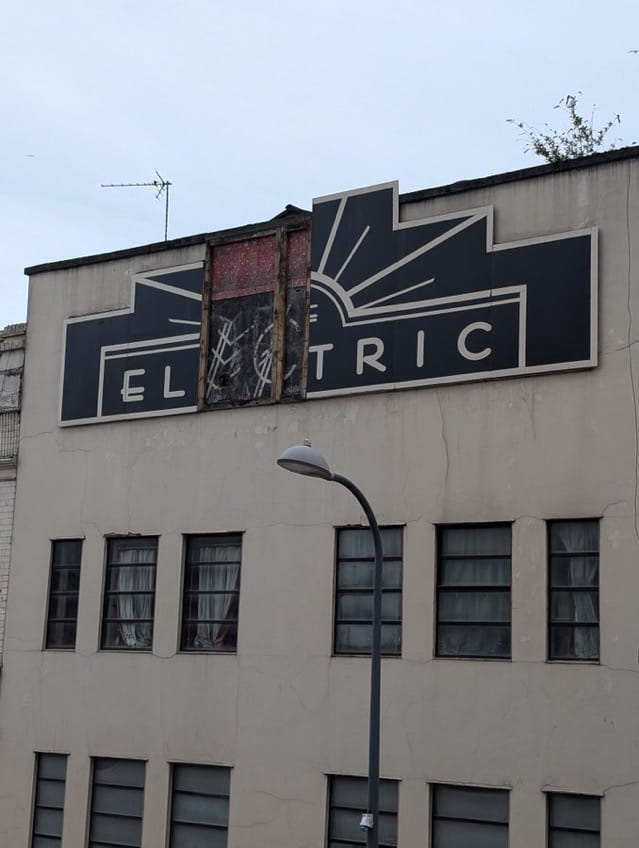
In hindsight, Francis’ campaign started the day the Electric announced its sudden closure at the end of February 2024. The news had barely begun circulating when he published a blog post about the cinema’s future, which triggered a huge national reaction.
The blog stated two things. One, the Markwick family who had been operating the Electric since 2020, had decided to close despite healthy attendance, because their 88-year lease had come to an end. (Francis admits this wasn’t based on hard box office figures, but an “anecdotal impression” of how the business was doing.)
Two: Francis revealed Glenbrook’s plan to: “apply for permission to demolish most of Station Street [....] to make way for a fifty-storey apartment block.”
Putting the blogpost out so promptly was a strategic move, Francis explains. He wanted to get ahead of the inevitable narrative that the Electric was doomed to fail.
“It’s easy for people in Birmingham to be a little bit defeatist because we’ve had a fair round of bad news over the last few years and there’s an element of, oh of course they’re going to knock it down,” he says. But if the Electric was to be revived, he knew they’d need not just cash, but “momentum and positivity”.
Francis’ manner doesn’t initially confer “momentum”: he’s reserved, with a dry sense of humour. Questions about his biography are met with short sentences, not a word wasted. But get him chatting about cinema, and suddenly he’s talking at 100mph, passion unlocked. Plus, he’s a guy who turned a monthly film night into an annual, hugely successful film festival. The more we speak, the more I see his impressive energy and drive. Most of our phone calls are conducted as he’s running between meetings.
Cinema isn’t just entertaining, it’s the people’s art form, he tells me. You can open a lot of doors with a film in a way that you couldn’t maybe with contemporary art or opera. Everyone feels like they have a right to an opinion on film. And it’s clear the Electric has a special place in his heart.
He discovered the venue when he first arrived in Birmingham in the Nineties, as a film student looking for work. That was harder to find, but what he did stumble across was the Electric. “I’ve spoken to people who remember cartoons or soft porn films in the Seventies, but for me, it was the art house era,” he recalls. He “didn’t really know anyone” in the city; the Electric changed that.
But it’s not really sentiment or financial interests motivating Francis. Yes, the Electric was Flatpack’s longtime incubator but when Kevin Markwick reached out in early 2024 to suggest the festival find another host that year, it wasn’t professionally disastrous. Flatpack had always made a point of nurturing relationships with different venues.
Sure, he’s got specific concerns for the city’s wider film scene (only two destinations — the Midlands Arts Centre and Mockingbird — remain to exclusively watch independent cinema, both with limited seating), and hates the thought of the story of the Electric “ending after all of these chapters”.
But ultimately, Ian Francis believes preserving (and evolving) this space is The Right Thing To Do, not just for the Electric but for the entire historic street and its hopes of cultural regeneration.
So in May 2024, when Glenbrook confirmed early plans to demolish the Electric, the Flatpack team announced they would be launching a challenge, in the form of an independent feasibility study. This was the £20,000, two-year research project that explored alternatives for the cinema beyond demolition, funded by grants from the British Film Institute alongside John Feeney Charitable Trust and the Architectural Heritage Fund.
Today, it has borne fruit, in the form of three fully costed proposals produced by Tim Ronalds Architects, a firm behind the revival of a raft of British heritage buildings. All the plans would keep the Electric as a functioning cinema and cultural space.
The pitch
Flatpack’s preferred option for the Electric would see the 1930s auditorium restored as the venue’s main screen, with a basement bar/restaurant and additional screening room. There would also be a third-floor extension built as an event and co-working space, complete with a part-time third screen. Mod cons would be plentiful: step-free access throughout the building, “modern, compliant toilet numbers” and better ventilation and insulation. The showstopper would be the removal of modern partitions and suspended ceilings to reveal the gorgeous historic detail of the building, like a 1930s proscenium arch that frames the stage. All this would cost at least £10m, which Francis says will be raised from investors and the public.
He’s pragmatic about the need for the venue to make a profit, including hospitality and space that can be rented out. “It can’t be solely reliant on selling tickets for films because we know that’s a difficult market at the moment," he says. “We’d have to have other levers to pull. If you want the building to thrive again, then you need to create those flexible spaces.”
I ask two experts what they think; David Rudlin, an architecture professor and government advisor on the New Towns programme, calls it a “great scheme”. As for Flatpack’s costings, a CEO of an arts venue in north west England, says it’s an “ambitious and well considered proposal by people who are making a serious effort,”. They do flag that its success would rest on favourable rent and a long-term lease, while fixed costs like business and utility rates might be coming in a little low.
All in all, Flatpack has the seal of approval: except from the actual company who owns the joint.
Birmingham deserves great journalism. You can help make it happen.
You're halfway there, the rest of the story is behind this paywall. Join the Dispatch for full access to local news that matters, just £8/month.
SubscribeAlready have an account? Sign In