

Is fascism making a comeback? This question reverberated throughout 2025, with politicians and commentators across the west warning against the rise of the far-right. In January, Sadiq Khan wrote in the Observer that there were “echoes of the 1920s and 30s” today, and in June, Nobel Laureates and academics from around the world signed an open letter warning of “a renewed wave of far-right movements, often bearing unmistakably fascist traits.” In September, record-breaking numbers of people marched on London for Tommy Robinson’s Unite the Kingdom rally.
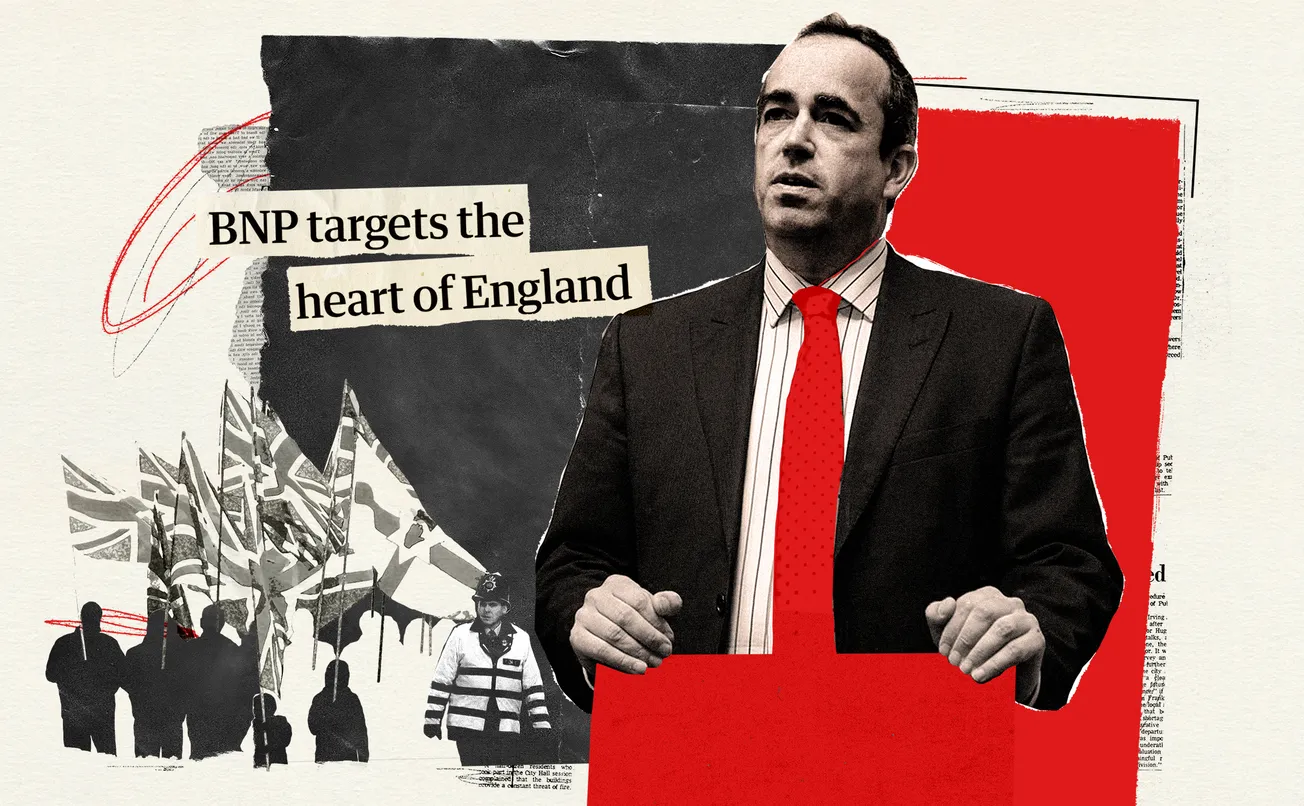
While fascism has mostly been kept from the political mainstream in Britain, it has had a significant number of supporters at times. Birmingham, and the wider West Midlands, have been pivotal to that story. To kick off 2026, we are publishing a series of three essays about key moments in the West Midlands during the history of British fascism. Following on from our last essay on Colin Jordan by academic Kevin Harris, we're publishing our final piece — on Simon Darby, the deputy leader of the BNP.
“Golliwog? Is that racist?,” asks a reporter.
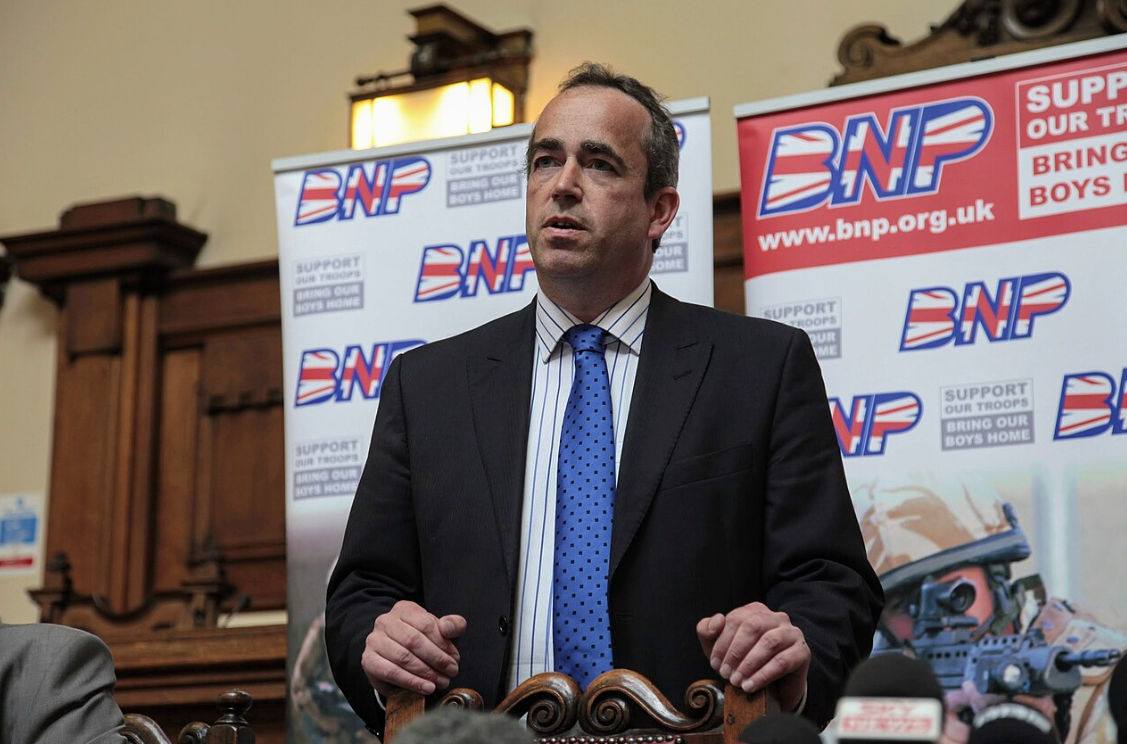
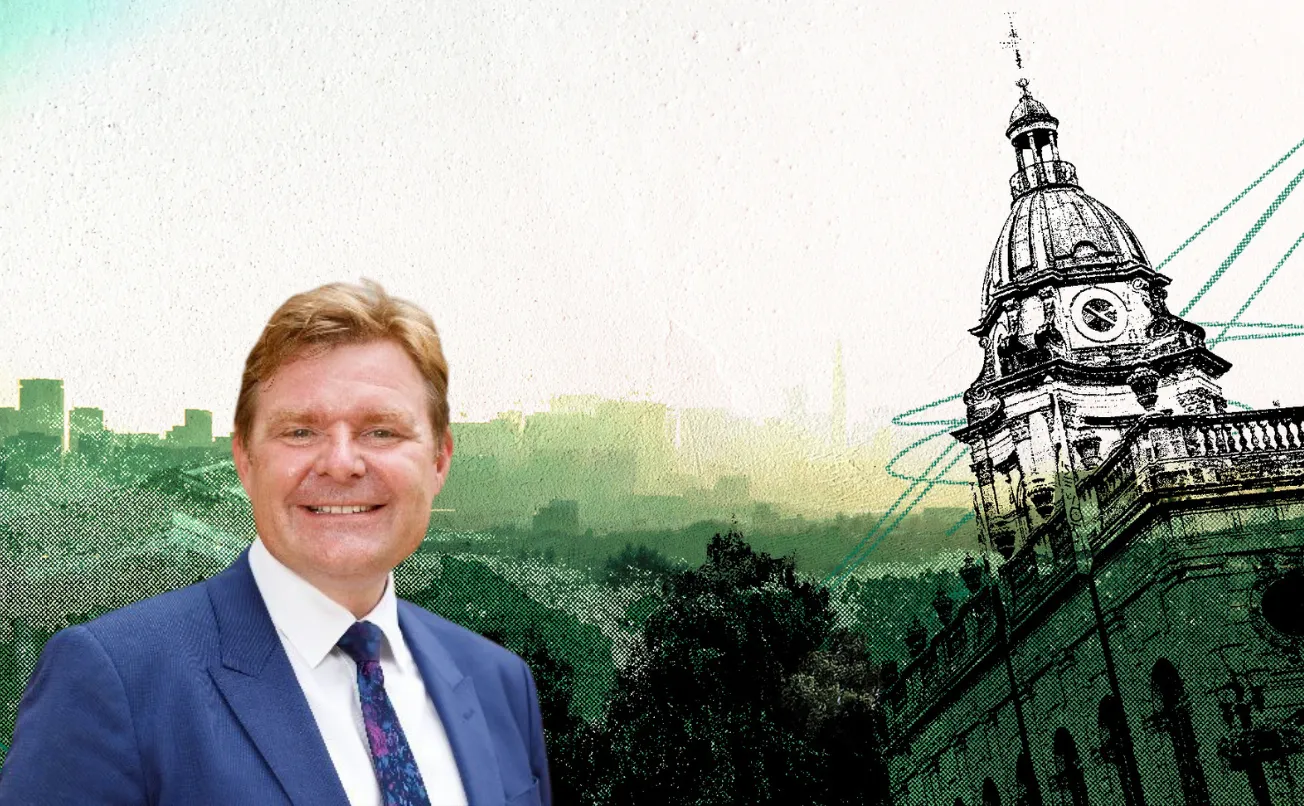
“It depends how you use it. I don’t think so [really] because it's an old English kind of word,” says Simon Darby. Darby is a middle-aged man, dressed in neat white slacks, a brown blazer and a bright-blue dress shirt. The former leader of the British National Party is sitting in a large gilded room in Birmingham. The year is 2012. “People associate [the word] with jam and marmalade,” Darby continues: straight-faced. “If you go out into the streets of Birmingham, you’ll see many black faces, right? They’d laugh at you if you said ‘golliwog’.”
Simon Darby is being interviewed by comedian Jolyon Rubinstein, for a BBC sketch show called The Revolution Will Be Televised. Darby doesn’t know this, of course — he thinks he’s talking to ‘Dale Maily’, a reporter. Every time Darby makes a discriminatory comment, Rubinstein meets him with an even more outrageous observation. It’s not clear how funny this game of chicken is, but it’s certainly illuminating.
Eventually, Rubinstein gets Darby onto the topic of Muslims in Birmingham: “Demographically, we’re outbred in our own country, by many who don’t belong here. The Muslim community [often] have five, six, seven kids. There is a deliberate policy going on in the Muslim community to use their wombs to replace us.”
In August 2012, during the height of the social liberalism of the coalition years (when politicians were urged to "hug a hoodie" and talk about the "Big Society"), Darby was a joke — the reactionary symbol of a far-right party in freefall: the perfect foil for a comedy sketch show. Tellingly, he was presented by the BBC as an oddball, a stick-in-the-mud middle-class racist, awkwardly sitting alone in a room both too grand and large for his lonely presence.
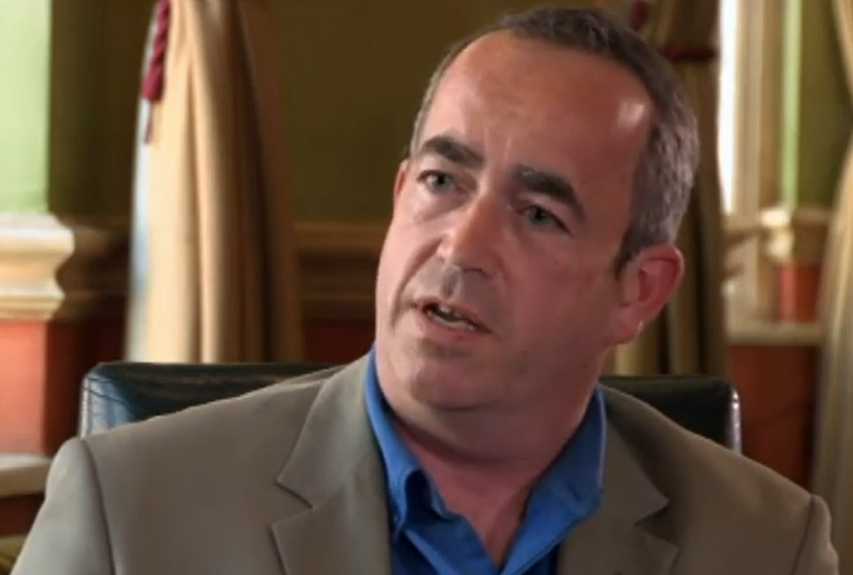
In front of the cameras and Rubinstein, Darby seems an odd figure: not an aggressive skinhead neo-Nazi familiar from the National Front in the 1970s and 1980s, and not a hyper-charismatic, salesman type, like Nigel Farage: native to the more moderate contemporary populist-right that has emerged since 2016.
Instead, Darby, seems withdrawn, almost shy — stuttering his racist pronouncements in a polished RP accent. Various journalists at the time noted his break with the harder-edged aesthetics of the 20th-century far-right: the jackboots and shaved head had been replaced by a businessman with interests in “the upholstery trade,” a degree in biology, and a large suburban house in Cannock.
West Midlands origins
Darby, born in West Bromwich, was also younger than the older racist far-right stalwarts like Nick Griffin and John Tyndall. He was a Gen X’er, who rose during the optimistic Blair years. At the time, he was presented by the party as a strange far-right shadow of a Blairite politician: well-groomed, tech-savvy, upwardly mobile and digitally competent. Notably, Darby didn’t associate with the BNP during its more openly fascistic phase under the leadership of John Tyndall during the 1980s and 1990s. Darby only came on board under the “modernising” tenure of Nick Griffin, when shirts and ties were donned, not bomber jackets and boots.
For Darby, before the BNP, there was the National Democrats. The group was an evolution out of the much larger, and more infamous, National Front. The party was founded in 1995, when a faction of the National Front voted to rebrand itself in an attempt to shed much of its toxic reputation built up over the 1970s and 1980s. The National Democrats, while Darby was a member, tried to branch out from racism, into ‘softer’ campaigns surrounding family values, including a "Paedophile Watch" website where accused sex offenders were registered.
The National Democrats, while never as popular as the BNP, had their main strongholds of support in the West Midlands, especially in West Bromwich. The party gained 11.4% of the vote there in the 1997 general election. As far as we can tell, Darby followed the National Democrats' leader, Ian Anderson, in the split from the National Front in 1995.
In 1998, after the triumph of Blair and New Labour, Darby joined the BNP, when his local National Democrat chapter defected to the larger party — which was understood as the ‘modernising’ vanguard of the British far-right: focused on elections and community politics over protests and open violence. Darby, and his West Midlands supporter base, which he took into the BNP, were instrumental in ousting the party’s former leader John Tyndall, a much more openly fascist politician, than his replacement Nick Griffin, who collaborated with Birmingham’s Colin Jordan, to found the first iteration of the BNP in the 1960s.
Welcome to The Dispatch. We’re Birmingham's new newspaper, delivered entirely by email. Sign up to our mailing list and get two totally free editions of The Dispatch every week: a Monday briefing, full of everything you need to know about that’s going on in the city; and an in-depth weekend piece like the one you're currently reading.
No ads, no gimmicks: just click the button below and get our unique brand of local journalism straight to your inbox.
Darby started as a local party organiser, rising to a council candidate by the early 2000s. At the same time, he was tasked with running the party’s technological innovations and organising its West Midlands wing. In 2001, the BBC profiled Darby, who was, by then, running the party’s “info-line,” an early attempt at an online audio-visual podcast. The profile detailed Darby playing music by the far-right Coventry-based band Avalon.
By 2003, he had won a seat on Dudley council — elevating him up the party ranks. At the time, Darby’s campaigning in the West Midlands was described by newspapers as a “BNP-led rebellion at the ballot box” and he was personally branded an “heir to Nick Griffin.” By 2006, the Guardian were describing him as: “the man BNP leader Nick Griffin has chosen to take over if he is convicted later this year on racial incitement charges.” Information is limited, but reporting puts much of Darby’s rise down to his comparative ease with the internet and PR campaigns, compared to older members. A year later, he was rewarded with the deputy-leadership by Griffin.
Darby’s wing of the BNP was competitive in council seats across the Black Country, outer Birmingham and small West Midland towns. During the mid-2000s, Darby’s branch of the BNP recorded good results in wards such as Castle & Priory (Dudley), Tipton, Walsall, Kingshurst & Fordbridge near Solihull, Kingstanding in North Birmingham and Cradley Heath in Sandwell.
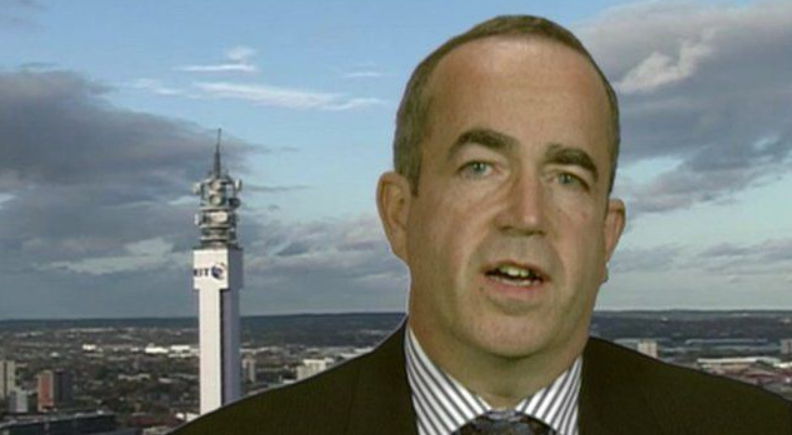
In these places, often at the forefront of deindustrialisation, mass unemployment and de facto spatial segregation, thousands of white working-class, and lower-middle-class voters had indicated their willingness to place ballots for the far-right party. According to data collected in a survey by the Joseph Rowntree Foundation in 2005: one in four electors at the time had considered voting for fascists.
In the same survey, the charity crunched the data on BNP support across England. In the 2000s, the common shorthand for far-right support was “poor, Northern, urban, ex- heavy manufacturing.” However, the survey revealed that it wasn’t just these stereotypically Northern towns hit by Thatcher that were turning away from Labour to the far-right.
Instead, discontent had spread into the West Midlands, which recorded the second highest level of support for the BNP in 2003, after the North West, at 23.8% of those sampled. In the 2004 European elections, support for the party in the West Midlands came second to Yorkshire, at 7.5% of the electorate.
Still, BNP voters continued to cluster closer to heavy industry and light manufacturing, with Black Country boroughs like Dudley (27.9%) and Sandwell (26.6%) far outstripping Birmingham (14.2%) in terms of ward-level support for the far-right. A 2003, MORI poll on immigration for the charity Migration Watch had also revealed that the West Midlands, along with the North East, held much stronger anti-immigration views than the rest of the country.
In 2006, Darby capitalised on this pre-existing support in the region to win four councillors on Sandwell Council, three representatives on Stoke-on-Trent’s council, and one councillor in Solihull. Retrospectively, the mid-2000s are thought of as an age of surging economic growth before the Great Recession of 2008 — however, in the West Midlands and many other parts of the country, this was not the case. Suddenly, Darby found himself being listened to as jobs haemorrhaged across the region. “It's amazing. This is new territory. We're used to being the target of a constant drip of hatred,” he told the Guardian. “Now, our message is being heard.”
In 2005, the year before Darby’s election successes, the British economy only grew 1.5%, the slowest increase since 1992. That year, major West Midlands industries announced closures: including Stoke-on-Trent’s Royal Doulton potteries, MG Rover’s Longbridge plant in South Birmingham, and Coventry South’s Ryton Car plant — laying off thousands of workers in the region. The Labour government at the time did nothing to save these industries, or prevent outsourcing, sparking a deepening alienation among former voters in working-class West Midlands areas.
This microeconomic downturn, alongside relatively high immigration levels, caused massive consternation over social housing and state resources in the area, something Darby played on in his campaigning. In 2006, a Guardian journalist reported how Darby was combining racism, a newfound Islamophobia (generated by the War on Terror, the 7/7 London bombings, rumours about the ‘Tipton Taliban’ and a furore over a Dudley mosque construction plan) with grievances around declining social services and a lack of council housing in places like Tipton and Dudley.
In 2006, during Darby’s campaign, the newspaper reported that unemployment was way above the national average and wages well below, in these areas, while council house waiting lists were skyrocketing in response to council-house sell offs, a lack of construction and increased inward migration. A common complaint from residents was that Kosovan asylum seekers were skipping ahead and taking up local social housing supply. While Darby wasn’t directly successful in Dudley — coming second place in many wards — he did manage to translate this alienation into victory across the border in Sandwell: winning Great Bridge, Princes End, and Tividale for the BNP.
Downfall
But just six years later, in 2012, Darby was nervously awaiting the latest set of election results. Things were not going well. The party’s candidate in Kingstanding, Sharon Ebanks, had accidentally been declared the winner after a miscount. No other seats in Birmingham or the Black Country were showing signs of swinging to the BNP. Darby had quit his role as the party’s deputy leader in 2010, writing to members that he “didn't really want to be drawn into the leadership question.” Despite stepping back from executive control, Darby stayed with the party during its downturn, serving as a spokesman for Griffin.
The year before, in 2011, the BNP had lost 11 councillors across England — with many votes flowing back to the Conservatives and UKIP. This was their chance to stem the tide. The BNP was facing an existential crisis. Membership was plummeting: lured by far-right groups with a stronger street presence, and charismatic leaders such as the English Defence League (under Tommy Robinson) and Britain First (under Paul Golding), or more openly euro-sceptical parties like the British Democrats. Others had moderated, and were trying to find their way into populist-right alternatives like UKIP. The field was suddenly very crowded.
Internally, Darby and Griffin now formed the loyal old-guard of the party, while rebellions sparked across the membership. A senior BNP MEP had quit the party over leader Nick Griffin’s management, and an ongoing court case was challenging their ‘whites only’ membership policy: causing discontent in the ranks. At the time, Darby and his party were staring into an abyss of public irrelevance and electoral wipeout.
That night in 2012 was disastrous for the BNP’s mainstream political hopes, with the party losing nine out of its 12 remaining council seats. Later, it would emerge that between 2008 and 2012, the party’s votes had collapsed from 240,000 to 26,000, a decline of almost 90%.
It’s unclear whether Darby is still a member of the now tiny BNP (300 members at last recording in 2018). After 2012, he faded into the ether. The latest on Darby, comes from a Hope Not Hate blog post from 2016, describing the former deputy leader as “held to ransom by the BNP over monies he was owed.” The blog post also describes Darby taking down many of his far-right-associated websites.
Clearly, Darby laid the foundations for a troubling politics in the Black Country — based around genuine material grievances. Support for the insurgent right is still strong in these areas — only now it's not the openly-racist far-right, but the more moderate populist-right in the shape of Reform UK. Indeed, according to MRP polling (which should be taken with a grain of salt), Reform UK has a 90% chance of winning in the Dudley parliamentary constituency, and 94% in Tipton and Wednesbury — both Labour seats.
Looking back to 2006, the most alarming thing is that Darby was playing on very real issues: structural unemployment, regional inequality, lack of housing, declining wages, the outsourcing of industry, and a lack of support for existing communities. These trends have only gotten worse since 2006.
In the 2000s, Labour had a cadre of veteran working-class politicians like Jon Cruddas, Maurice Glasman, and Frank Field who managed to beat back the BNP. Now, vast swathes of the West Midlands could fall to Reform with little opposition.
There isn’t an identifiable Simon Darby figure leading a populist right-wing insurgency this time around — but the momentum is so strong that there probably doesn’t need to be one. Perhaps the best way to understand the upcoming local elections across Birmingham and the Black Country in May 2026 is to reflect on 2006. After 20 years, we still live in the world where Darby found it so easy to persuade the public to tick a box for the far-right in the voting booth.
If someone forwarded you this newsletter, click here to sign up to get quality local journalism in your inbox.
If you’d like to sponsor editions of The Dispatch and reach over 25,000 readers, you can contact us or visit our advertising page below for more information
28/01/2026 correction: An earlier version of this article described West Bromwich as being in Staffordshire. This has been corrected.

Comments