

Dear readers — Operation Fearless might sound like something from an action movie (perhaps that's the point) but it is actually an initiative launched by West Midlands Police in Erdington in 2025. The point? To use data to target specific areas where crime is rife, flood the location with policing resource, and crackdown on criminals as much as possible in a short space of time. After an expansion to the city centre last year, the mission has now come to Handsworth — an area whose residents have historically suffered discrimination and brutality at the hands of the law. Some locals are desperate for police intervention to mitigate the risks of rising crime — others are staunchly against it. That's today's story.
But before that, your Brum in Brief.
Brum in Brief
👮 A man has been charged with murder following the death of a pub-boss who was punched and died in hospital three days later. Police were called to the Ricco and Loren cocktail bar in Lichfield late on Sunday night after reports that two men had been assaulted. Matt O’Gara, director of the Plough pub in Huddlesfield, later died in hospital. Billy Allison, 36, from Solihull has been charged with murder and will appear at Stafford Crown Court today.
💰 Birmingham city council has fined itself more than £470,000 because its own vehicles (most of them from the waste department) break the city’s Clean Air Zone policy. (BBC).
💬 Birmingham Reform has faced criticism from Labour for demanding that only English be used in meetings. The demand came after an imam read an Islamic prayer at the swearing in ceremony of the new lord mayor. (BirminghamLive).
The handlebars of the bike shake as it turns, at speed, onto a tree-lined street. Up ahead a figure is sprinting, a rucksack and jacket strewn behind him in the middle of the sun-dappled tarmac. The cyclist races over the debris and onto the pavement, chasing his target who is now scaling a brick wall.
“Stay where you are!” he screams. Leaping off the bike, he grabs the man from the wall and pins him to the ground.
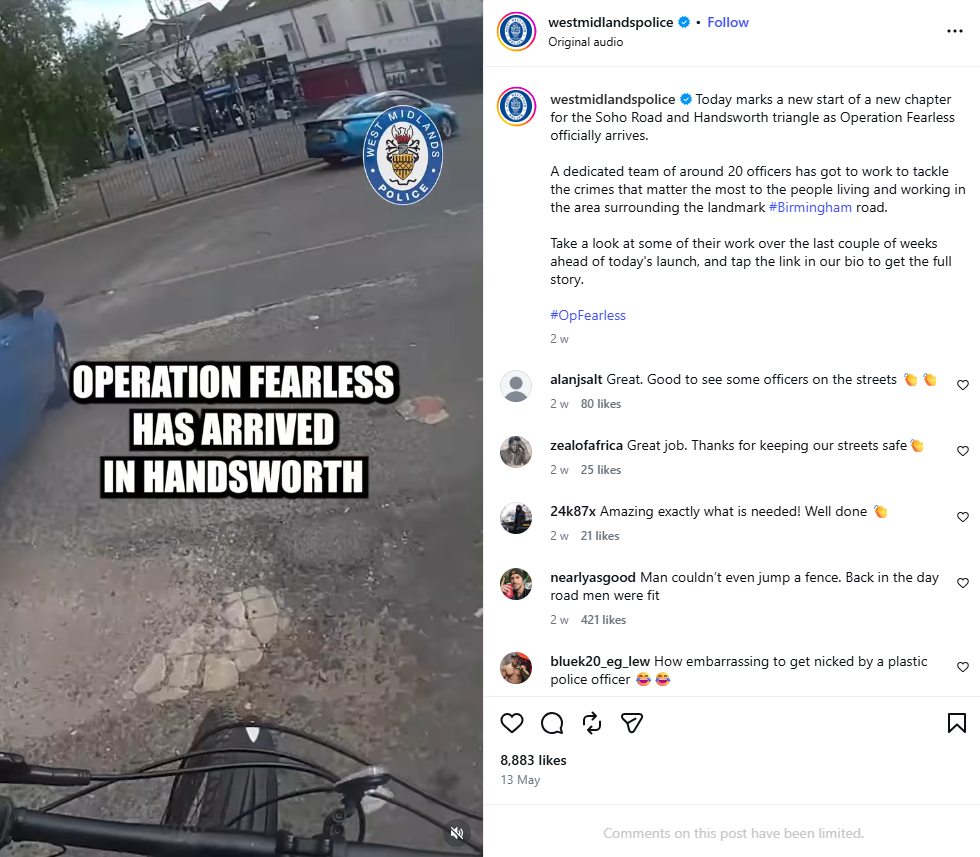
The snippet of bodycam footage is part of an action-filled montage, accompanied by high-energy techno music, recently posted to the West Midlands Police Instagram page. In one similar clip, a cop leaps out of a moving car to arrest a man in a hoodie; in another, a battering ram collides with a jade-green front door.
The police launched Operation Fearless in Handsworth on Wednesday 13 May. The initiative involves 20 officers being deployed to the ‘Handsworth triangle’ and the Soho Road for an undisclosed period of targeted crime-solving. So far, just over a fortnight in, they have carried out at least 60 arrests, and recovered a cache of cash, mobile phones, and Class A drugs. They have even seized a large sword.
This is ‘hot-spot policing’, a data-driven strategy that identifies a location where crime is disproportionately common. Police direct resources to the area, including a mix of high-visibility and plain-clothed patrols, stop-and-search, and warrants to search homes. The aim is to act as both a deterrent and to protect potential victims from being targeted by criminals.
Hot-spots are strictly a short-term tactic. “There’s no permanent cleaning up Dodge city so that the bad guys never come back,” says Emeritus Professor of criminal and community justice at University of Strathclyde, Mike Nellis. “It's a war of attrition that goes on and on and on with ebbs and flows, depending on what effort organised crime is putting in and depending on what effort the police are putting in.”
Hot-spot policing has been around in the UK since the 1990s but was rolled out nationally in 2021 and continues to be widely used. Operation Fearless was first launched in Erdington last year. Funded by £880,000 of money confiscated from criminals, it was soon expanded to Southside in the city centre. Now, West Midlands Police has honed in on and around the Soho Road, where they’re concerned with anti-social behaviour, drug dealing, knife crime, and mini-mart shops thought to be connected to organised crime groups.
Some residents, and local Labour, Lib Dem, and Green politicians, say the measure is much-needed. In a recent Facebook video, Independent Perry Barr MP Ayoub Khan revealed he (and local business and resident groups) “constantly lobbied” West Midlands Police to bring Operation Fearless to the area.
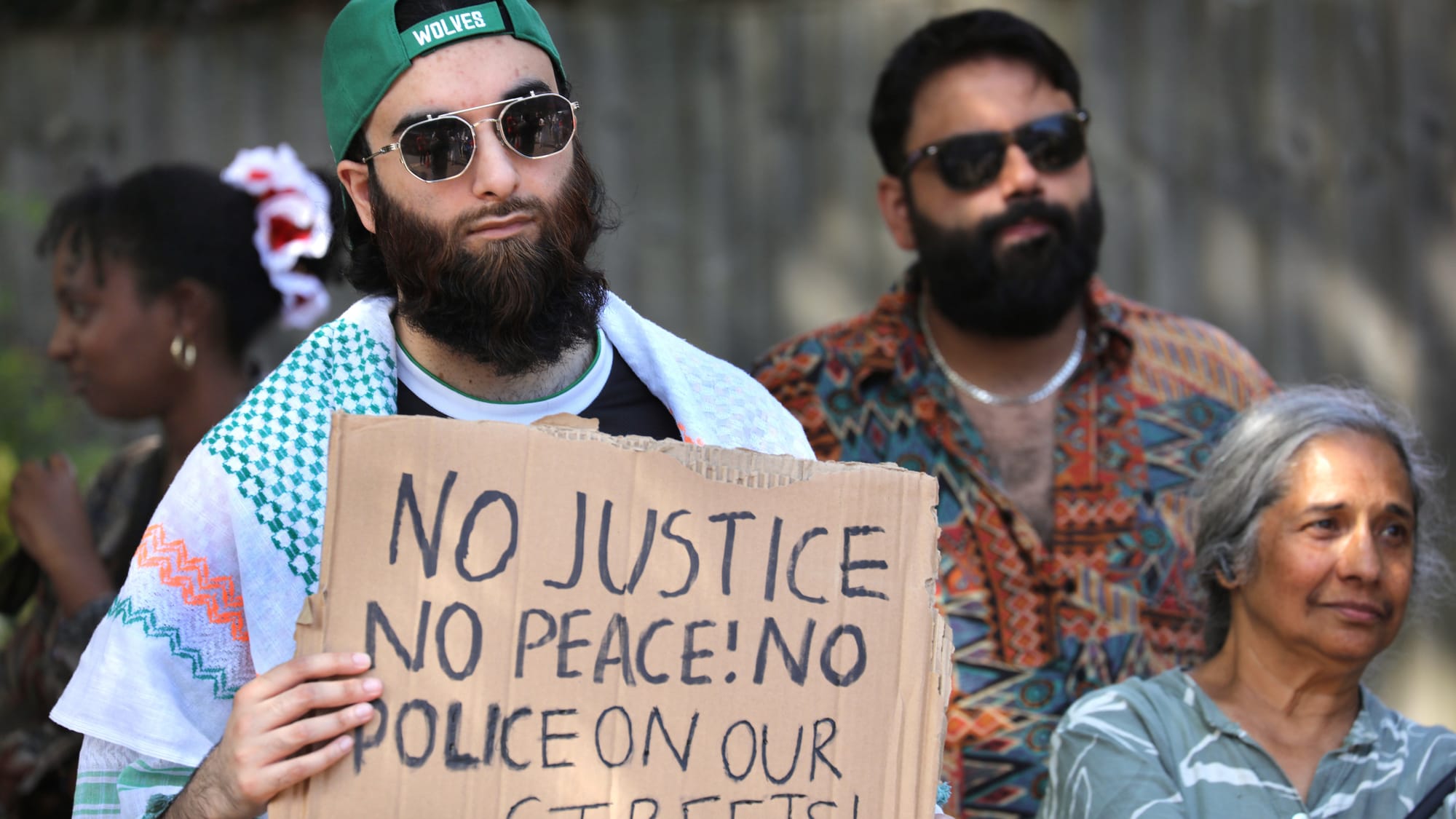
But it also has its critics. Last Saturday, around 60 people gathered on Soho Road to protest the expansion, with video interviews suggesting attendees were primarily concerned about the potential Operation Fearless has for racist policing and increased surveillance of migrants. Videos show people of all ages (though predominantly young people) assembled in the sun, a couple of whom are playing drums in the background.
“Handsworth is a place that has been consistently deprived of the resources that it needs,” says Saajan Singh, a Handsworth resident and member of the Birmingham Revolutionary Communist Group (RCG), one of several organisations that planned the demonstration. “Historically it has always been deprived and over-policed as a result.”
Of all three areas where Operation Fearless has been carried out, Handsworth probably has the most febrile history of community-police relations. The 1980s and 1990s saw periodic riots (or uprisings, depending on who you speak to) where complaints of police brutality, discrimination, and use of excessive force were widespread. This was especially true of the 1985 disturbances which occurred against a backdrop of high rates of unemployment and poverty and reportedly started after a Black man was arrested in nearby Lozells, and police raided the Villa Cross pub.
Saajan argues that the use of stop and search tactics by police today replicates the ‘sus’ laws of the eighties – controversial legislation used by police to apprehend suspicious-seeming individuals – that in practice were disproportionately used against young Black men. The Birmingham RCG’s other major objection to Operation Fearless is the inclusion of immigration checks in the remit, which they claim gives the false impression that migrants are to blame for the rise in crime.
In actuality, says Saajan, crime happens in Handsworth because consistent deprivation has destabilised the local community. The closure of youth centres has led to young people being at risk of joining criminal gangs. The large number of people working precarious jobs in the gig economy are more likely to resort to crime to meet their basic needs. Fund these needs, he says, and that’s how to reduce crime, not by bringing in cops. “That’s sociology 101,” he adds.
While the Dispatch approached the West Midlands police for an interview for this story, they declined and sent us a statement instead. Det Chief Inspector John Askew, from Operation Fearless, said: “Since launching in January 2025, the operation has maintained a proud track record of listening to communities and tackling the issues reported to us, contributing to significant drops in knife crime, youth violence, and anti-social behaviour.” He added that the use of stop and search “when used correctly, can be an effective way of reducing crime and bringing offenders to justice – and we have already made significant arrests and recovered weapons as part of this. We have a robust system in place to monitor these searches, which are recorded on body-worn video, and we regularly speak to independent community groups about our use of these powers, so they can scrutinise it.”
This story is free to read - you just need to join our mailing list. And why wouldn't you? By becoming a Dispatch subscriber, you'll get our scoops, features, and insights, in your inbox, the second we hit publish. No card details required.
Already have an account? Sign In