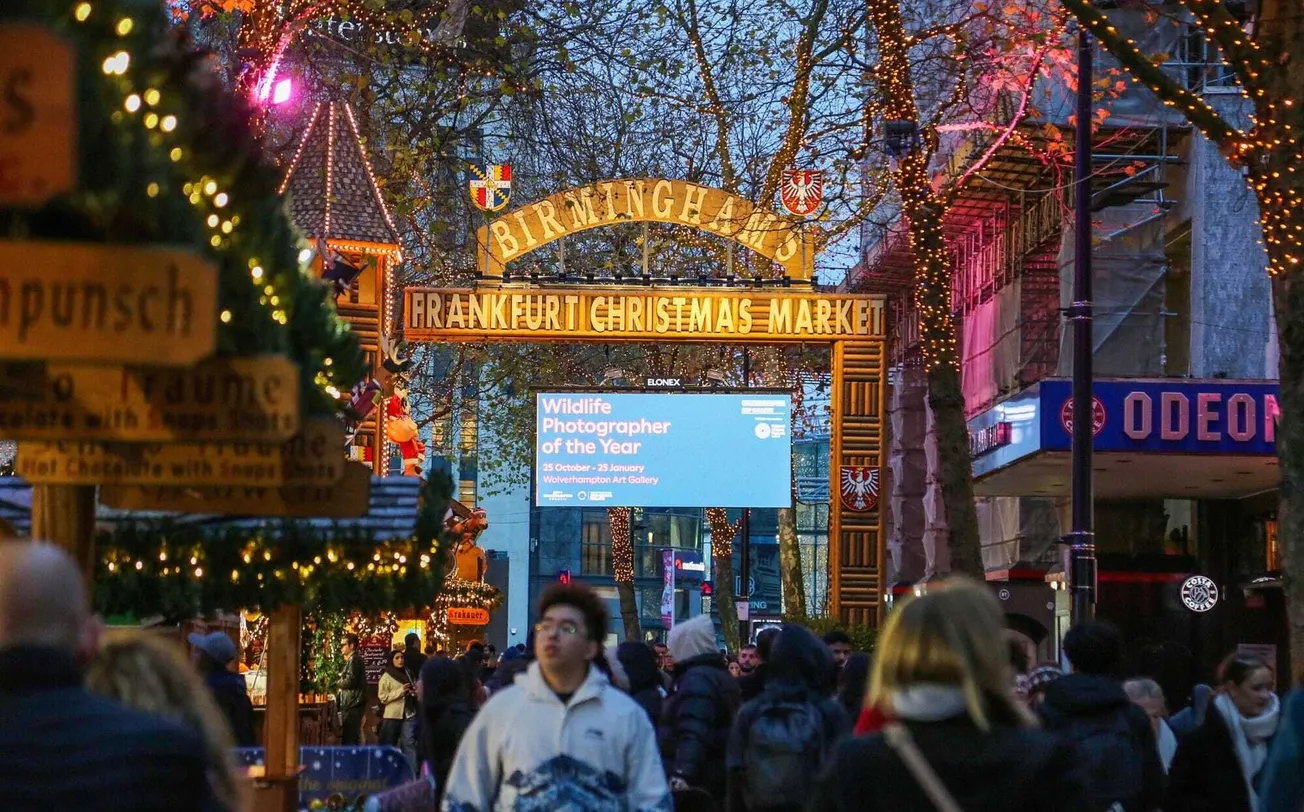


Before we get into today’s piece, join us in donning a party hat and treat yourself to a slice of cake, because last week The Dispatch’s turned three. And we think marking three years of quality independent journalism in Brum deserves a proper fanfare.
To celebrate, we’re making every single piece completely free to read, including our entire archive until 9 November.
We’ll share some recommendations to dig into later in the week, but for now, a huge thank you from all of us at The Dispatch for helping us go from strength to strength!
A few weeks ago it happened again. With some effort the city gathered itself; fortified its ramparts and roused its battle-weary regiments. Like sharpened blades, its favoured arguments were withdrawn from weathered scabbards. No! Look at the good stuff! The Victorian buildings in the city centre! A growing visitor economy worth £14 billion! Harper’s Bazaar calling Birmingham a ‘city with swagger’!
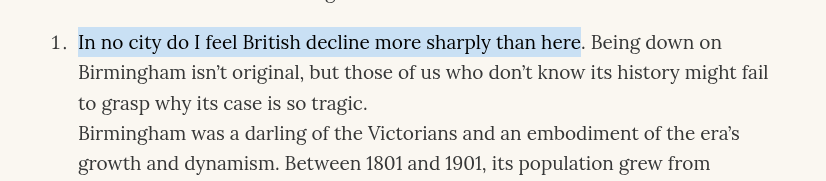
This time, rather than a Conservative MP’s vlog, or a newspaper expose, it was a blog post by the co-founder of think-tank the Centre for British Progress that brought out Birmingham’s defence league. “In no city do I feel British decline more sharply than here,” wrote Julia Willemyns, echoing The Times in 2025 (“metaphor for squalid national freefall”) and The Telegraph that same year (“the poster child of national decline”).
Counter evidence submitted to The Dispatch was of a similarly familiar tenor. A recently retired Labour councillor blames national cuts. If the city has declined, he says, and he’s not so sure it has, then 14 years of austerity would be the reason. A tour guide gives me a charmingly upbeat appraisal, and says “numerous” clients have compared the city centre to Paris.
The four horsemen.
City council leader Roger Harmer, sends us a long list of reasons why Birmingham is not down and out, including that Time Out has “recommended [Birmingham’s] restaurants, pubs, galleries and attractions”, and the above quote from Harper’s Bazaar. This email reminds me of the time I went for a car ride with Joe Anderson, the deposed and disgraced former mayor of Liverpool. He presented me with a printed multi-page document listing all his achievements as mayor, among them seeing the city ranked as ‘Tripadvisor’s third best UK travel destination of 2018’.
Of course, Harmer makes a number of other points, many more solid, like the recent growth of the local visitor economy. But I can’t help but feel there’s a disconnect whenever this topic surfaces, and the defences are thrown up. Everyone must secretly know that the fundamentals of the critique are accurate: that enormous sections of Birmingham feel extremely poor, badly run and dejected. Reading Harmer’s email, I imagined myself wandering up into Alum Rock or Kingstanding with a copy of Harper’s Bazaar tucked under my arm trying to explain that, no, this is a city with swagger! Come on guys, Aston Villa won the Europa League!
Birmingham isn’t broken. There are genuinely good omens: those recent investment numbers are positive, and there’s deep and rich history to build on. But the basic statistics tell us that, relative to the rest of the country, or continent, Birmingham is doing very badly indeed. Pick your issue: bad housing, poverty, unemployment — Birmingham scores among the nation’s worst for all of them. Ladywood is the national leader in child deprivation, just as Erdington is for youth unemployment.
“Birmingham and the wider West Midlands has declined relatively within the UK for decades,” says Tom Forth, founder of Data City and former Birmingham resident. “The economic data on this is clear and irrefutable. Too much time is wasted questioning the data rather than trying to fix the problem.”
Annoying as the presence of panting bloggers and pith-helmeted Times employees with their cameras and columns may be, if you spend a day walking round most of the city you’ll encounter no end of people just as brutal in their assessments. I should know because I did it.
Earlier this week, I walked Birmingham, or at least a good two-thirds of it. Down through Sparkbrook, then Sparkhill into Billesley, over to Moseley and into Stirchley, down into King’s Norton, back up via Bourneville to Harborne and Edgbaston, all the way up to Smethwick, over through Soho and Handsworth into Perry Barr and up to Kingstanding. Then my legs got tired.
I feared at some point I’d approach someone, ask them whether their city, site of their most cherished memories and the people that matter most to them, is actually the national capital of degradation, and they’d smack me in the face. But no one did. I spoke to 42 people in total: more than half of them cheerfully agreed.
Council houses and the Council House
A young man in a crisp white shirt is using Moseley Wetherspoons to conduct a series of important business calls. “I think we need to be more proactive,” he says down the phone. He’s called Hugh. He nabs a booth here because it’s better than working from home and he can’t yet afford office space, plus there’s unlimited coffee refills.
Moseley is the kind of place people slagging off Birmingham are often instructed to check out: it feels like a village, and its farmer’s market is said to be the cream of the Midlands for local produce. Hugh likes it, but that’s where his positivity about Birmingham ends. He recently travelled to Glasgow on business and his eyes were prised open. “Jesus fucking Christ,” he thought, deciding there and then to buckle down and find a way out of Brum.
This story is free to read - you just need to join our mailing list. And why wouldn't you? By becoming a Dispatch subscriber, you'll get our scoops, features, and insights, in your inbox, the second we hit publish. No card details required.
Already have an account? Sign In