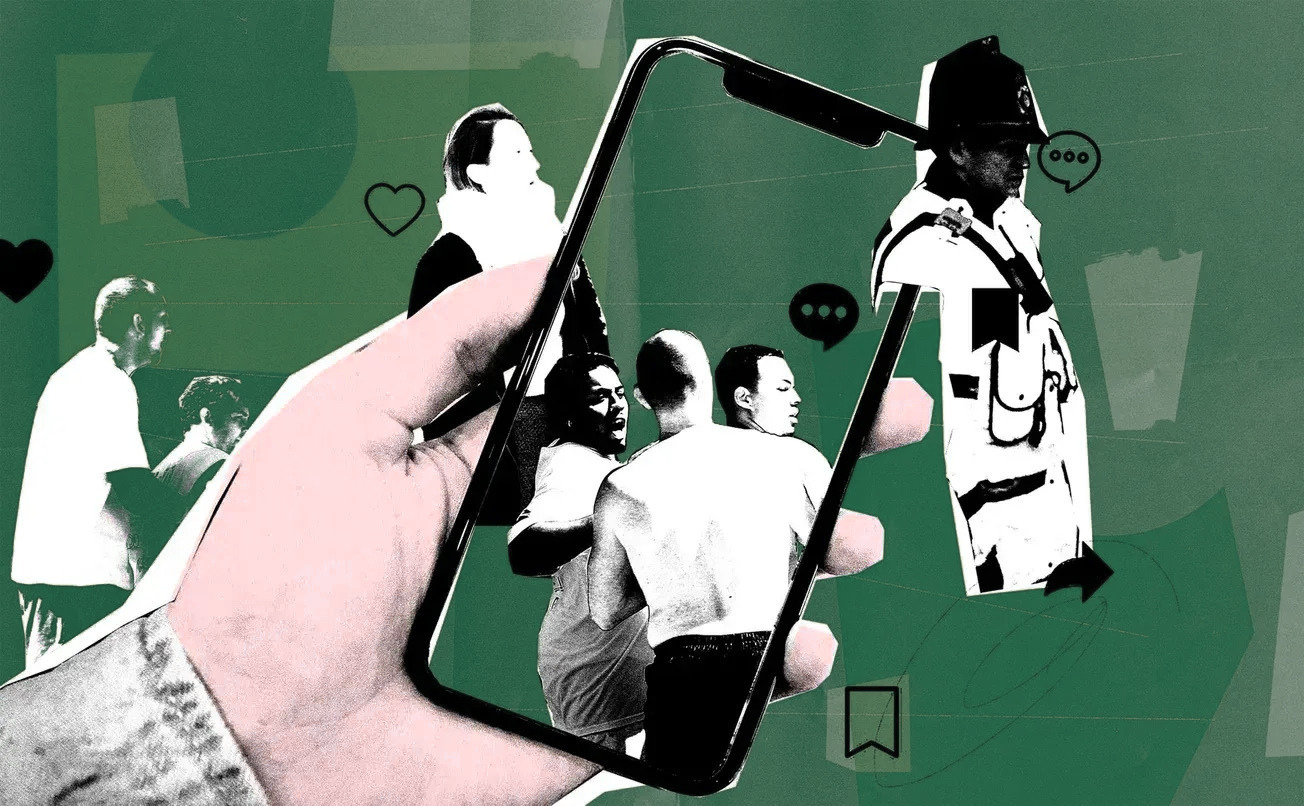

Dear readers — today we delve into the debate around smartphones and children’s safety. How are schoolkids in Birmingham being affected by their pocket computers? And should they be banned?
Brum in Brief

🚨 Around 40 demonstrators gathered in Victoria Square last night as part of nationwide protests in the aftermath of a knife attack in Northern Ireland on Monday. A 30-year-old Sudanese man called Hadi Alodid has been charged with the attempted murder of 40-year-old Stephen Ogilvie, who lost an eye. Footage of the attack in the Kinnaird Avenue area of north Belfast circulated widely on social media, leading to a call for protests in 70 cities around the UK that were promoted by Tommy Robinson on X. Yesterday, riots saw homes and cars set alight across Belfast. (Express and Star). (The Independent). (The Guardian).
🪧 But tensions did not appear to flare in Birmingham. One eyewitness who was there until about 7.45pm, told The Dispatch that the city centre demo was a quiet affair with “no chanting or speeches, just people standing around chatting, some drinking beer, some smoking weed”. They added that some people let off red, white, and blue smoke flares but that was about as animated as it got.
⚖️ Home Secretary Shabana Mahmood has confirmed new powers for local authorities to shut down illegal mini-marts for up to a year, following an ongoing investigation by the BBC. She announced the change on Soho Road, where the police are honing in on criminal-connected shops as part of Operation Fearless, and which The Dispatch wrote about last month. (BBC).
🗣️ A new Green Party councillor and Birmingham city council cabinet member has hit back at “false” claims that he praised Hamas’s 7 October attacks on Israel. The Palestinian councillor for Stirchley, Kamel Hawwash, was the subject of a Times article on Monday that claimed a post by him online described the 2023 onslaught as “courage in the face of aggression”. The story has since been picked up by GB News and Birmingham Live, with members of Birmingham’s Jewish community calling on council leader Roger Harmer to reconsider Hawwash’s appointment. However, Hawwash told ITV that the phrase came from the title of a Lebanese news segment on which he had appeared. “Suggesting that these words were my own is a gross misrepresentation,” he said. (ITV).
“Do you think I’m a strict parent?”
The children eye me suspiciously from the other side of the laptop. They were midway through an episode of Junior Taskmaster when I sidled in clutching a notebook and hit the space key.
“You let us do baking. And get our ears pierced. And you’re not too strict about bedtime,” the 10-year-old sister offers.
“What am I strict about?” I ask.
They exchange a glance.
“Screen time.”
In the last couple of years I’ve become increasingly conscious of the harms posed by excessive online use, especially for children. In his 2024 book, The Anxious Generation: How the Great Rewiring of Childhood Is Causing an Epidemic of Mental Illness, American social psychologist Jonathan Haidt drew on studies of young people since the 2000s to argue that overprotective parenting combined with smartphones and social media has led to an explosion in youth anxiety.
Haidt’s critics argue that much of the rising levels of youth depression and anxiety could be attributed as much to the rocky state of the world as it could to smartphones. Plus, as one expert in adolescence points out in the Guardian, Haidt’s findings have also coincided with an increase in obesity, an increase in academic pressure and the Covid pandemic, “all of which are associated with worse mental health.”
Still, few could disagree with his thesis that childhood is no longer as “play-based” as it once was – something he attributes to overprotective parents and increasing smartphone use. But the effects of smartphone use don’t end at the boundaries of North America. In her resignation letter last month to Sir Keir Starmer, as she stepped down from her position as safeguarding minister, the Birmingham Yardley MP Jess Phillips cited the PM not legislating to bring in technology that would block children’s ability to take naked images of themselves. A couple of days ago, in an op-ed for the Mirror, she wrote: “The entire business model of global paedophile rings and also just the local isolated sex abusers relies on children being duped and groomed to take naked images and live stream their abuses. The only tool they need is a phone.”

The situation Phillips is citing feels like an extreme – a worst case scenario that I hope would not apply to the vast majority of children and teenagers. However, I’m aware that most young people in Birmingham have a level of screen access that would have been alien to me as a child. So how are they faring? Last week, I spoke to educators across the city to try and gauge how smartphones are shaping the next generation of Brummies.
“I've seen such a massive change since I've been teaching,” one teacher in a secondary girls school in north Birmingham tells me. “Students are really tired in lessons, and that's because the girls say that they are sometimes up to two, three in the morning on their phones chatting. There's a huge amount of FOMO [fear of missing out] if their friends are doing this, so they join in because they're going to be left out.”
Parents are in despair, she says. “They don't want to take the phone away because it causes a huge meltdown. They allow their child to have a phone, and they're aware that at night the child is using their phone instead of going to sleep and they don't know how to deal with that.” Many come to parents evenings asking the teachers for guidance. Though smartphone use is not allowed in the school, some students have two phones – one they put away for the school day and one they keep and take out on trips to the toilet.
The same teacher thinks there are cultural issues at play. “The [school’s] population is mainly Asian and they haven't got the freedom that other kids have” – their home lives are “family-oriented” and they aren't allowed to go out and meet other young people, she tells me. “We're finding more and more that they are trying to escape that through online discussion platforms.”
Some of these schoolgirls are just talking with their friends, like we did on landlines in the 1990s to the annoyance of our parents. Others with strangers. While parents don’t allow the girls to meet boys in person they aren’t savvy to what’s possible on social media. “The girls are going onto online discussion forums – there's one called Discord, which they're using more and more – and they join communities with similar interests but then they're targeted by older men and persuaded to leave and go on to WhatsApp and more private platforms.” The school has referred grooming cases to the Child Exploitation and Online Protection branch of the National Crime Agency.
Birmingham deserves great journalism. You can help make it happen.
You're halfway there, the rest of the story is behind this paywall. Join the Dispatch for full access to local news that matters, just £8/month.
SubscribeAlready have an account? Sign In